WP1 synthesised relevant innovation aspects for the next generation of ecosystems RIs supporting a Whole System Approach. It serves as a pilot between eLTER PLUS project and the eLTER ESFRI process.
WP2 analysed and identified shareholders and described and characterised their needs and requirements. It aimed at strengthening the links with Sites and Platform Coordinators and developed relationships with other European and global RIs.
WP3 developed recommendations for the selections of Standard Observations. It identified in-situ design needs for remote sensing calibration and produced a review on standardisation of variables and protocols at European level.
WP4 developed workflows for harvesting from different information sources (statistics, satellite data etc.) and integrating with eLTER data to create Information Clusters. These will be piloted into the eLTER Data Information Portal (DIP)
WP5 developed and organised trainings for different stakeholder groups. The training covers subjects related to site operations, data management, and scientific approaches like Whole System Approach.
WP6 built and actualised a communication strategy for the project. It built and maintained various communication channels for project internal and external communication needs.
WP 7 organised annual Transnational and Remote Access calls open to the scientific community also beyond project beneficiaries. It also took care that eLTER Central Data Node is well populated with data for Virtual Access.
WP8 explored how long-term biodiversity, biogeochemistry, hydrology and socio-ecological data from eLTER network can provide a holistic understanding of the ecosystems response to environmental and societal pressures. The focus was on the site and catchment scale.
WP9 assessed and synthesised activities at the pan-European network scale, and identified improvements in the network’s ability to address research questions. WP9 was complementary to WP8.
WP10 established the eLTER RI data service function and access portal requirements for data acquisitions, data quality control and analytical workflows.
WP11 worked on new and innovative exercises extending the existing eLTER information infrastructure and piloted these new workflows as fully operational eLTER RI services.
WP12 offered free-of-charge opportunities for researchers to run ecological and socio-ecological projects by visiting eLTER Sites. This WP included the work that needed to be done by site personnel.
WP13 facilitated geographically widespread access to the many eLTER sites in a time efficient and cost-effective way. Site personnel will run a protocol of a RA project on behalf of the researcher themself.
WP14 maintained eLTER data management tools and enabled virtual access to eLTER datasets through DEIMS-SDR, eLTER DIP and eLTER CDN, and related services. It also supported the data providers.
WP15 took care of the strategic and practical management of eLTER PLUS. It covered all scientific, technical, administrative, financial and legal matters.
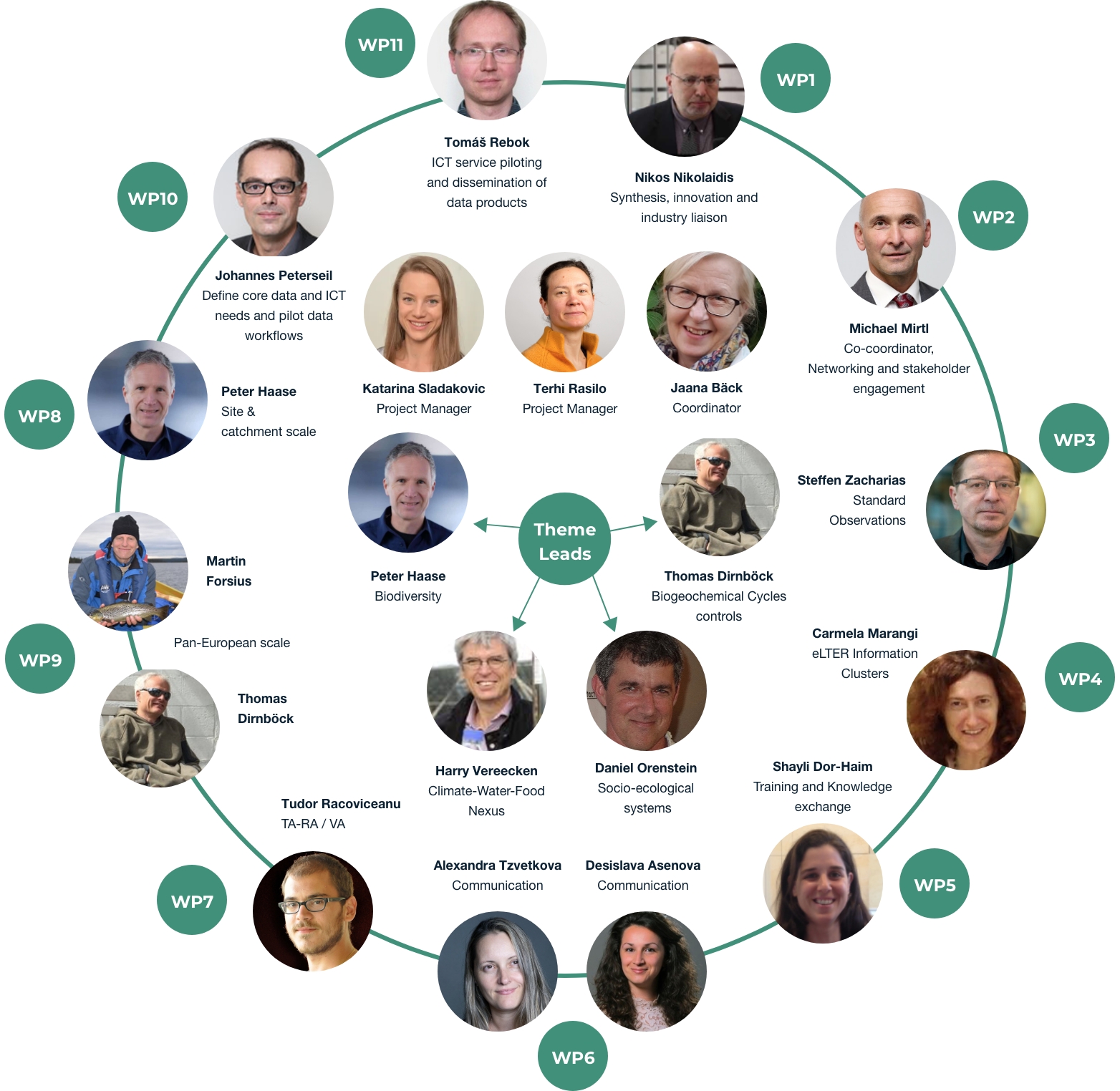
The role of Work Packages
eLTER PLUS consisted of one management WP and 14 other Work Packages. WP3 & WP4 were devoted to harmonising observation methods, WP7 improved network services through advanced workflows for Virtual Access, WP8, WP9 and WP11 fostered Research and Innovation for the RI through 3 Joint Research Activities, and WPs 12–14 provided physical, remote, and virtual access to sites and platforms. WP1, WP2, WP5, WP6 provided networking activities focusing on community building, outreach, training and dissemination activities. WP15 took care of the overall coordination and management activities.